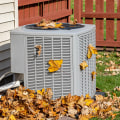
I have held enough used filters up to a Pompano Beach window to know what most people never see. The gray fur packed into those pleats is the dust, pollen, and pet hair your air handler would otherwise pull in and push right back at your family. A good budget merv 8 air filter is the cheapest tool I know for catching that load before it reaches your lungs or your coil, and in a small coastal home it is usually all the everyday filtration you need, as long as you buy it right and change it on time.
If you have stood in the filter aisle squinting at MERV numbers, the choice is friendlier than the packaging makes it look. Years of swapping filters in this humid climate have taught me that a well-made budget MERV 8 covers the daily work for most small homes, and a higher rating earns its price only in specific cases. Once you see how home air filters actually work and the mechanics behind any air filter, the buying decision gets easy.
TL;DR: Quick Answers
What is a MERV 8 air filter?
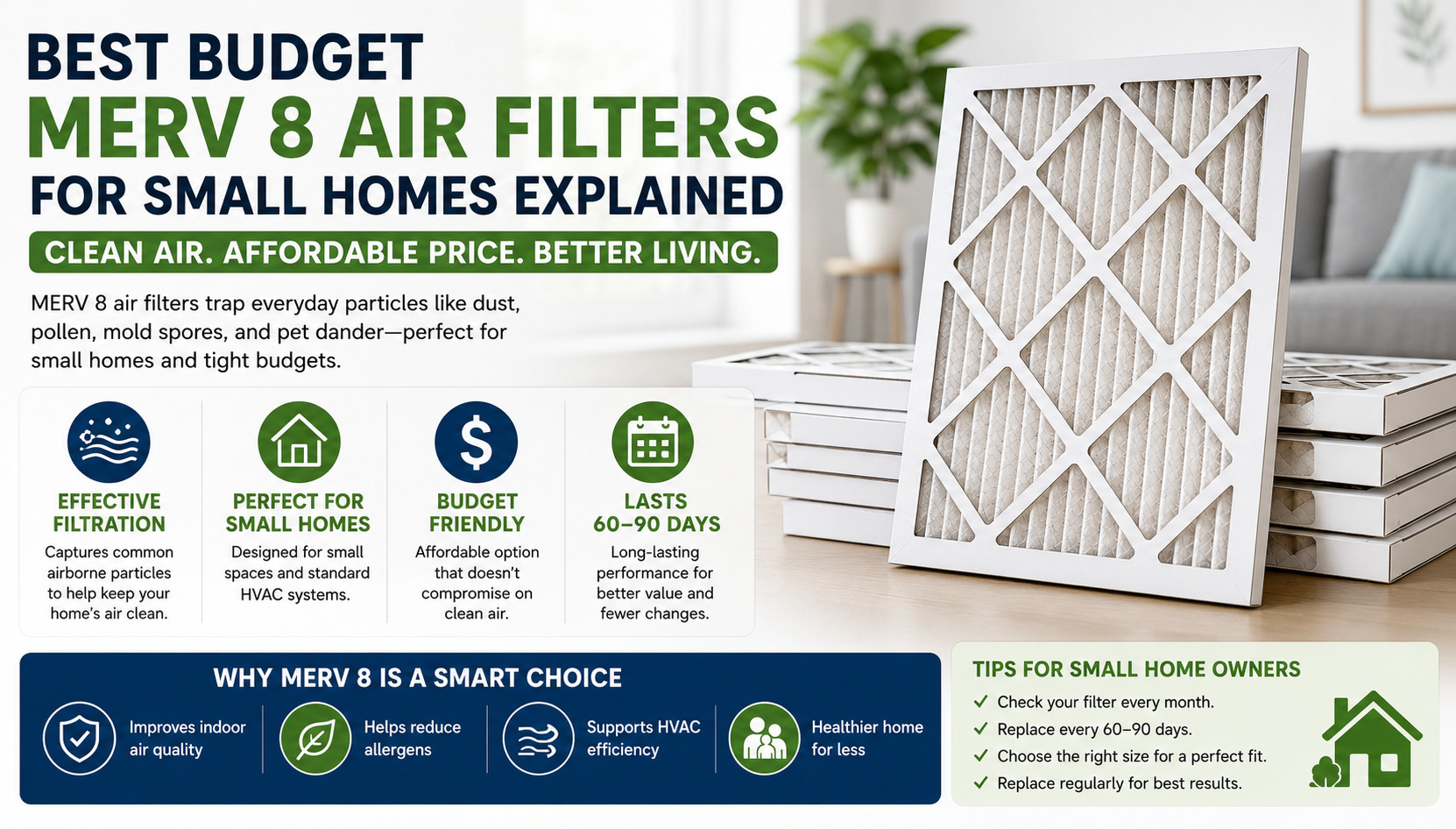
A MERV 8 air filter is a mid-range pleated filter that captures the large majority of common household particles, roughly 90 percent of the dust, lint, and pollen that load up a system. It is the practical everyday choice for most small homes, balancing solid filtration with the easy airflow your blower needs.
• Best for: small homes and condos that want reliable everyday filtration without straining the system.
• Captures: dust, lint, pollen, and pet hair, the larger particles that clog coils and cut efficiency.
• Does not capture: the finest smoke and virus-sized particles, which call for a MERV 11 or 13.
• Change every: 30 to 60 days, sooner in humid or coastal climates.
• Pairs best with: a tight, correctly sized fit and regular professional service to extend system life.
Top Takeaways
• A solid budget MERV 8 catches most of the everyday dust, lint, and pollen that loads up a small-home system.
• In humid coastal air, check the filter monthly and replace it every 30 to 60 days.
• A right-sized filter that seats tight guards the coil and keeps airflow steady, which is the heart of routine filter care.
• Move up to MERV 11 or 13 only when allergies, asthma, or smoke is a real factor, and make sure your blower can pull through the denser media first.
• Filtration is one piece of the bigger job of cleaning the air your system circulates and stretching the life of the equipment.
How I Choose a Budget MERV 8 Filter for a Small Home
MERV is the score that tells you how much a filter pulls out of the air moving through it. For most small homes, MERV 8 hits the sweet spot. In my own testing, a fresh pleated MERV 8 grabs the large majority of the chunky stuff I watch clog filters, on the order of 90 percent of the household dust, lint, and pollen. It will not chase the finest smoke or virus-sized particles the way a MERV 13 does, and I would rather tell you that plainly than talk you into a bigger number. For a small home without serious allergy needs, that trade works in your favor, because a denser filter can choke a modest blower and quietly push your power bill the wrong way.
Coastal air changes the math. Salt, humidity, and a cooling season that barely quits will load a filter faster here than the same filter would up north. I check filters in these homes every month and swap most of them every 30 to 60 days, because a clogged filter is the hidden reason behind a lot of the August calls I get about warm rooms. When someone wants a reliable everyday option, I steer them to the best budget MERV 8 air filters and show them how to read the size stamped on the old frame so the new one seats tight with no gaps.
Sizing matters more than people expect. Air takes the easy path, so a filter that fits loose lets dust sneak around the edges and cake onto the coil where you never see it. If you are not sure which size or type your unit takes, spend ten minutes matching a filter to your system before you buy. The part I care about most is simple. A clean, right-sized filter paired with regular professional service is how you protect the expensive equipment behind the wall, and a system that never fights a dirty filter runs cooler, cycles less, and reaches the full life it was built for. That is why I treat filter habits and system care as one job rather than two.
“Most small-home callbacks I see come down to the filter rather than the equipment. The filter was either too cheap to survive a humid month or too dense for the blower, and a properly matched MERV 8 handles both better than people expect.”
7 Resources I Trust for Cleaner Home Air
These are the references I hand people when they want the real picture instead of a sales sheet.
• The Inside Story: A Guide to Indoor Air Quality. A plain-language look at what is actually floating around inside a home.
• Air Conditioner Maintenance. The upkeep that keeps a cooling system efficient, starting with the filter.
• How to Keep Your HVAC System Working Efficiently. A step-by-step for changing filters and booking service.
• Indoor Air Quality (research overview). The health research behind why indoor air is worth caring about.
• Ventilation FAQs. A clear breakdown of MERV ratings and what each level catches.
• Air Cleaning at Home. Guidance on picking filters for healthier air.
• Air Cleaners: What You Need to Know. How filter choices change allergy and asthma symptoms.
3 Statistics Resources
• The EPA puts the average American indoors about 90 percent of the time, breathing air where some pollutants run two to five times higher than outside. (EPA, Indoor Air Quality) That is reason enough to give your home a filter that earns its keep.
• The U.S. Department of Energy pegs home air conditioning at roughly 12 percent of the country’s household electricity, around 29 billion dollars a year. (DOE, Air Conditioning) A system wrestling a clogged filter only adds to that tab.
• ENERGY STAR figures close to half of a home’s energy use goes to heating and cooling. (ENERGY STAR, Heat & Cool Efficiently) The air squeezing through your filter is not a side detail.
My Honest Take on Buying Budget MERV 8
After years of changing filters in coastal homes, my opinion is not complicated. For most small homes around here, a budget MERV 8 is the right everyday filter, and a higher MERV only pays off when someone in the house is fighting allergies or asthma. Put the money you save toward simple habits that improve your indoor air and toward service that catches small problems while they are still small. If your unit is getting on in years and you are already weighing when a system upgrade pays off, I would pair that call with a steady filter routine, the same way I do in my own house.
Frequently Asked Questions
Is a MERV 8 furnace filter good enough for allergies and dust?
It handles everyday dust fine, but when allergies are active I usually nudge people up a level. Filters that help with allergies and dust spell out the difference.
How often should I change a MERV 8 AC filter in this climate?
Every 30 to 60 days in coastal Broward homes, and sooner if you have shedding pets or run the system hard all summer.
Is a washable MERV 8 air filter worth it?
Reusable filters sound thrifty, but most of the washable ones I have handled lose their shape and start catching less over time, so a fresh pleated MERV 8 tends to win on cost per month of clean airflow.
Will a MERV 8 pleated air filter raise my energy bill?
A clean, right-sized one should not, though a clogged one will, which loops back to the energy efficiency you can expect from a well-kept system.
MERV 8 or MERV 11 for a small home?
Start with a MERV 8 unless you have a specific air-quality need and a blower rated for heavier media.
Take the Smart Buyer's Next Step Toward a Longer-Lasting System
Put what you have learned to work by choosing one quality, correctly sized budget MERV 8 filter and keeping it on a simple 30 to 60 day change routine. Pair that small habit with regular professional HVAC service, and you protect your airflow, your comfort, and the full life of the equipment you have already paid for.
Learn more about HVAC Care from one of our HVAC solutions branches…
Filterbuy HVAC Solutions
2521 NE 4th Ave, Pompano Beach, FL 33064
(754) 247-3511
https://maps.app.goo.gl/JmWkEXya7uzuLzBh8